
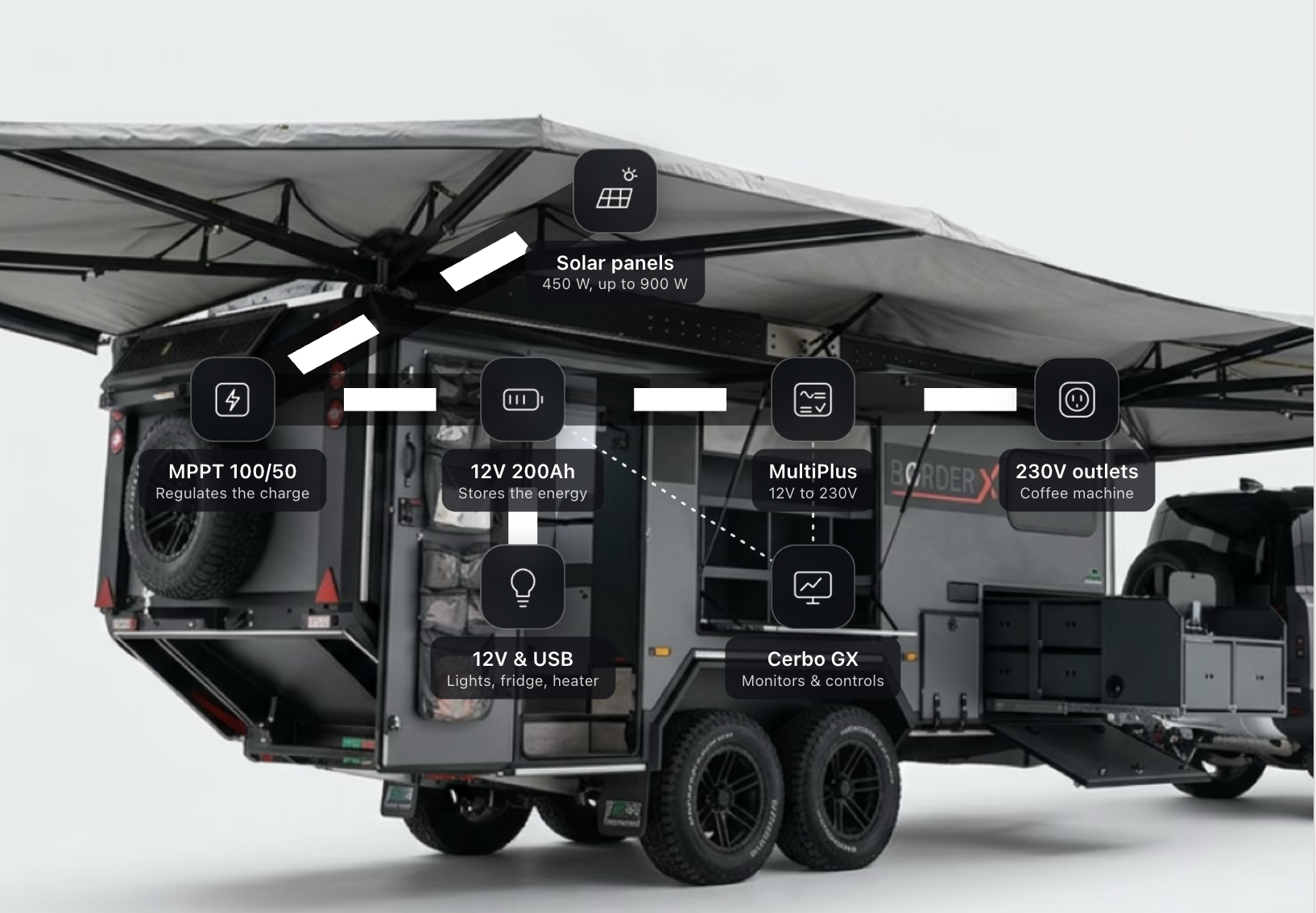
There's something magical about waking up in the middle of nowhere — no campsite, no hook-up, just you, your caravan and a view of the mountains. But real freedom off-grid doesn't happen by accident. It's engineered. Every BorderX and Gibson off-road caravan comes equipped with solar panels and batteries that work together as one smart system, so the sun does the hard work while you enjoy the adventure.
Solar panels: your silent power plant on the roof
It starts on the roof. The solar panels convert daylight into energy, which is stored in the caravan's batteries for later use. And the sky's the limit — literally.
The Gibson off-road caravans come with 2 × 140 Watt panels as standard, while the BorderX now features a 450 Watt solar setup as standard — rising to 600 Watt in 2027. Want more? On the BorderX, you can order up to 2 × 450 Watt panels from the factory, giving you a generous 900 Watts of solar capacity. Even on days when the sun hides behind the clouds, that's more than enough to keep your system charged.
Batteries: where the energy lives
All that solar energy needs somewhere to go. That's the job of the batteries, which store everything the panels collect during the day. An MPPT voltage and current regulator makes sure every watt harvested is stored efficiently and safely.
The batteries power everything you need for comfortable living: interior and exterior lighting, the fridge-freezer combination, the control current for your heater, the 12 Volt and USB connections, and the inverter — which converts 12 Volt into 230 Volt for those little luxuries, like your Nespresso coffee machine.
Gibson: solid AGM power
The Gibson caravans carry 3 × 12 Volt 100 Amp AGM batteries. Use your installation sensibly — for example, only switching on the inverter when you actually need to charge your laptop — and you'll have more than enough energy left to keep the fridge-freezer running through the night and beyond, light your evenings and keep your phone or iPad charged.
BorderX: smart lithium technology
The BorderX caravans take it a step further with a Victron 12 Volt 200 Amp SuperPack NG Lithium battery with a built-in Battery Management System. It's an incredibly intelligent battery that, working together with the complete Victron electrical installation, does everything the Gibson setup does — running your fridge-freezer, lighting and USB connections — but with extra advantages. It can discharge much deeper without damage than AGM batteries. And in combination with the Victron MultiPlus, it can even upgrade a 4 Amp shore power connection — normally not enough for your Nespresso — to 10 Amps, keeping everything running smoothly even on a modest campsite hook-up.
AGM or lithium: which one do you need?
As you've read, there are real differences between battery types. Let's be clear: AGM batteries are good, solid batteries that work perfectly in off-road caravans. You absolutely don't need lithium to hit the road. But lithium does give you more possibilities:
65% lighter in weight — leaving you more payload capacity at the same amperage.
Deeper discharge without damage — AGM can be discharged to around 60-70%, lithium to 95%. That means using power longer without harming your battery.
Longer lifespan — a lithium battery lasts roughly 1.5 to 2 times longer than AGM.
The catch: price — lithium is considerably more expensive, roughly 3 times the price of AGM.
So... how long can you stay off-grid?
The honest answer: it depends entirely on your power consumption. Which appliances are running? How many Nespressos do you make per day? How often does the fridge have to work overtime because the lid was left open? Are you actually freezing in the fridge compartment, or just keeping things cool at 5 degrees?
Our own experience? Two weeks in the south of France, using the fridge-freezer, USB, lighting and more — and we never plugged into shore power once. In fact, we came home with a higher battery voltage than when we left. And that was with AGM batteries and just 2 × 140 Watt of solar.
True off-grid living is about more than power
Of course, energy is only part of the equation. If you have a chemical toilet and use it frequently, you'll need somewhere appropriate to empty it — a campsite, for example. And never in nature! You'll also want enough food and drink on board.
In short: going off-grid depends on several factors — your supplies of food, drink, power and toilet capacity. Get all of those right, and there's only one thing left to say: enjoy that beautiful spot with a view of the mountains. You've earned it.
